Have you ever come away from a conversation feeling as though you and the other person were having completely different discussions?
Perhaps you left feeling misunderstood. Perhaps they did too.
Neither of you intended to get it wrong, yet somehow the connection didn’t quite happen.
When autistic people experience communication difficulties, these misunderstandings have often been explained as difficulties that sit primarily within the autistic person.
But what if communication difficulties go both ways?
A Different Way of Understanding Communication
In 2012, autistic researcher Damian Milton introduced the concept of the Double Empathy Problem (Milton, 2012).
The theory suggests that communication difficulties between autistic and allistic (non-autistic) people arise because allistic people have similar difficulty understanding autistic people, just as autistic people have difficulty understanding allistic people. Research has shown that difficulties in understanding do occur in both directions (Sheppard et al., 2016).
Rather than viewing communication as something one person is responsible for getting right, the Double Empathy Problem encourages us to think about communication as something that happens between people.
Understanding Difference Rather Than Deficit
One of the reasons the Double Empathy Problem has resonated with so many autistic people is that it offers a shift away from a purely deficit-based understanding of communication.
For many people, it reflects something they have experienced throughout their lives but struggled to put into words.
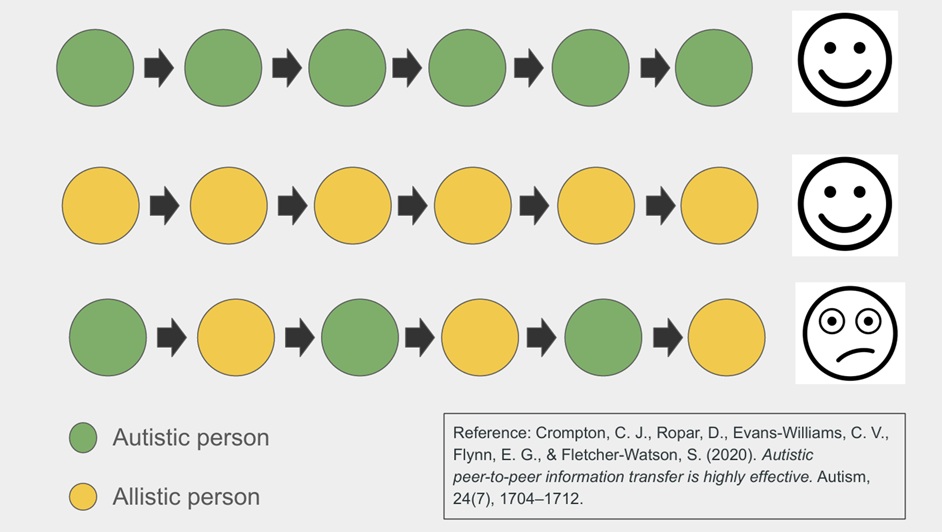
Research has found that information was passed just as effectively through groups of autistic people as through groups of allistic people. Communication became less effective when information passed between alternating autistic and allistic individuals, suggesting that differences between neurotypes may play a significant role in communication challenges (Crompton, Ropar, et al., 2020).
This suggests that many communication difficulties may be better understood as differences rather than deficits.
For example, autistic and allistic people may use different signals to show engagement, rapport or interest. Studies exploring rapport have found that autistic and allistic people often rely on different social signals. Behaviours such as eye contact and verbal affirmations may be interpreted differently depending on neurotype (Rifai et al., 2022).
Research has also suggested that autistic people may ask more questions in order to gain clarity, whereas allistic people may sometimes interpret frequent questioning negatively (de Marchena et al., 2025).
Understanding that there are different ways of communicating can be particularly important in workplaces, where communication styles are often shaped by unspoken expectations about professionalism, engagement and collaboration.
Why This Matters
How we understand communication differences matters.
When misunderstandings are viewed as a problem within one person, it can create pressure to constantly adapt, mask or monitor how they communicate.
Many autistic people describe spending significant amounts of energy trying to interpret unwritten rules, hidden expectations and indirect communication styles. Many have also received feedback on how they should improve their communication in ways that align with allistic norms.
Research has also shown that allistic people can sometimes form negative impressions of autistic people early in interactions and may be less inclined to continue those interactions when communication feels unfamiliar (Alkhaldi et al., 2019; Sasson et al., 2017).
But when we begin to recognise communication as a shared process, the focus moves away from fixing people and towards understanding differences.
We can become more curious.
We can ask more questions.
We can make fewer assumptions.
And we can start thinking about what might help communication work better for everyone involved.
Instead of asking:
“Who is getting communication wrong?”
we might ask:
“What would help us understand each other better?”
What Can We Do Differently?
The Double Empathy Problem does not suggest that communication difficulties disappear.
Rather, it encourages us to approach them differently.
Small changes can often make a significant difference:
Being clearer about expectations and intentions
Allowing space for questions and clarification
Recognising that people may communicate interest, respect and engagement differently
Being open to different communication styles
Approaching misunderstandings with curiosity rather than judgement
These approaches can be valuable in workplaces, families, friendships and professional relationships.
Moving Towards Mutual Understanding
One of the things I appreciate most about the Double Empathy Problem is that it moves us away from the idea that one person needs to be fixed. Instead, it invites us to think about communication as something we create together.
When we recognise that people process, perceive and communicate differently, we create opportunities for greater understanding, flexibility and connection.
Communication is not simply about saying the right thing.
It is about building enough shared understanding for people to feel heard, respected and able to be themselves.
When we become curious when communication doesn’t go as expected, rather than assuming one person is responsible for the misunderstanding, we often create more opportunity for genuine connection.
Thank you to everyone who has already taken part in the survey. Your experiences, insights and reflections are helping to shape this workbook and ensure it reflects real communication experiences rather than assumptions.
If you haven’t yet completed the questionnaire, I would be very grateful if you could take a few minutes to share your thoughts. Every response helps build a richer understanding of communication differences and contributes to creating a more useful and meaningful resource.
Take the questionnaire here
REFERENCES
Alkhaldi, R. S., Sheppard, E., & Mitchell, P. (2019). Is There a Link Between Autistic People Being Perceived Unfavorably and Having a Mind That Is Difficult to Read? Journal of Autism and Developmental Disorders, 49(10), 3973–3982. https://doi.org/10.1007/s10803-019-04101-1
Crompton, C. J., Ropar, D., Evans-Williams, C. V., Flynn, E. G., & Fletcher-Watson, S. (2020). Autistic peer-to-peer information transfer is highly effective. Autism, 24(7), 1704–1712. https://doi.org/10.1177/1362361320919286
Crompton, C. J., Sharp, M., Axbey, H., Fletcher-Watson, S., Flynn, E. G., & Ropar, D. (2020). Neurotype-Matching, but Not Being Autistic, Influences Self and Observer Ratings of Interpersonal Rapport. Frontiers in Psychology, 11. https://doi.org/10.3389/fpsyg.2020.586171
de Marchena, A., Cuneo, N., Gurbuz, E., Brown, M., Trujillo, J., & Bergstrom, J. (2025). Communication in Autistic Adults: An Action-Focused Review. Current Psychiatry Reports, 27(8), 471–481. https://doi.org/10.1007/s11920-025-01616-6
Milton, D. E. M. (2012). On the ontological status of autism: The ‘double empathy problem’. Disability & Society, 27(6), 883–887. https://doi.org/10.1080/09687599.2012.710008
Rifai, O. M., Fletcher-Watson, S., Jiménez-Sánchez, L., & Crompton, C. J. (2022). Investigating Markers of Rapport in Autistic and Nonautistic Interactions. Autism in Adulthood, 4(1), 3–11. https://doi.org/10.1089/aut.2021.0017
Sasson, N. J., Faso, D. J., Nugent, J., Lovell, S., Kennedy, D. P., & Grossman, R. B. (2017). Neurotypical Peers are Less Willing to Interact with Those with Autism based on Thin Slice Judgments. Scientific Reports, 7(1), 40700. https://doi.org/10.1038/srep40700
Sheppard, E., Pillai, D., Wong, G. T.-L., Ropar, D., & Mitchell, P. (2016). How Easy is it to Read the Minds of People with Autism Spectrum Disorder? Journal of Autism and Developmental Disorders, 46(4), 1247–1254. https://doi.org/10.1007/s10803-015-2662-8